
LLM SEO: How to Get Your Content Cited in AI Search
By: Danika Olsen, Published June 17, 2026
Where Does Your Site Stand in AI Search?
Not sure whether AI tools are surfacing your content? Send us the pages that matter, and we’ll check them against what actually earns citations and point you to the quickest wins.
Get My Free Check →What You’ll Learn
What Is LLM SEO, and How Is It Different From Traditional SEO?
LLM SEO is the practice of structuring your brand and content so AI systems can understand it, trust it, and cite it when they answer a question. You’ll see the same idea under two other names:
Does LLM SEO Replace Traditional SEO?
No — LLM SEO is a pivot in how you approach content, not an abandonment of SEO fundamentals. Traditional SEO best practices still come first. You still want to rank on page one, ideally in the top three, because that is where the clicks and the buyers are — the top three organic results take nearly 69% of all clicks, and interest drops off sharply after that. What you add on top is the pivot itself: the same content and the same fundamentals, restructured so a model can pull a clean answer fast.
How Do AI Models Actually Use Your Content?
A large language model doesn’t scan your page for an exact-match phrase — it reads for meaning. But before any of that, it has to find your content, and the major systems don’t all look in the same place. Whatever the platform, building an answer comes down to three moves:
Where Each System Looks (and Why It Matters)
There is no single “AI index.” Each major system is wired to a different source of truth, so being visible in one doesn’t mean being visible in the rest. Here’s who pulls from where:
| AI system | Pulls content from | How it finds sources | Reach |
|---|---|---|---|
| Google AI Overviews & AI Mode | Google’s own index + Knowledge Graph (custom Gemini) | “Query fan-out”: many sub-searches across Google’s index | ~2B users/mo |
| Gemini (app) | Live Google Search (grounding) | Real-time Google results | ~750M users/mo |
| ChatGPT Search | Microsoft Bing index (+ OpenAI’s OAI-SearchBot) | Bing API plus OpenAI’s own crawl | ~800M users/wk |
| Perplexity | Its own index + live web | PerplexityBot crawl + per-query sub-searches (RAG) | ~780M queries/mo |
| Claude | Brave Search | Web-search tool, real-time, inline citations | tens of M/mo |
Should You Optimize for a Specific AI Agent?
You don’t pick one. Chasing each platform separately is a losing game — the indexes differ and most give you no usable data. What they reward is remarkably consistent: clear, answer-first content from a site indexable in both Google and Bing, with crawlers unblocked. Anchor your measurement on Google’s AI Overview, the one surface where AI Overview impressions and clicks show up in Search Console.
Optimizing Content for AI Search: Why One Page Gets Cited and Another Doesn’t
Most of what earns an AI citation is the work a careful writer already does: lead with a clear answer, structure the page cleanly, and back up the claims. To see how much structure alone can do, take a question we rank for ourselves. Search what is keyword cannibalization and Google assembles its AI Overview from several sources — and one of them is ours, cited for the clearest example, even though our domain authority is a fraction of the competition’s. A well-known industry tool ranks #2 right above us with 11.7 million backlinks, and it’s nowhere in the answer. Authority didn’t decide the box; structure did.
Nothing crisp to extract → not cited.
Clean, liftable chunk → pulled into the AI Overview.
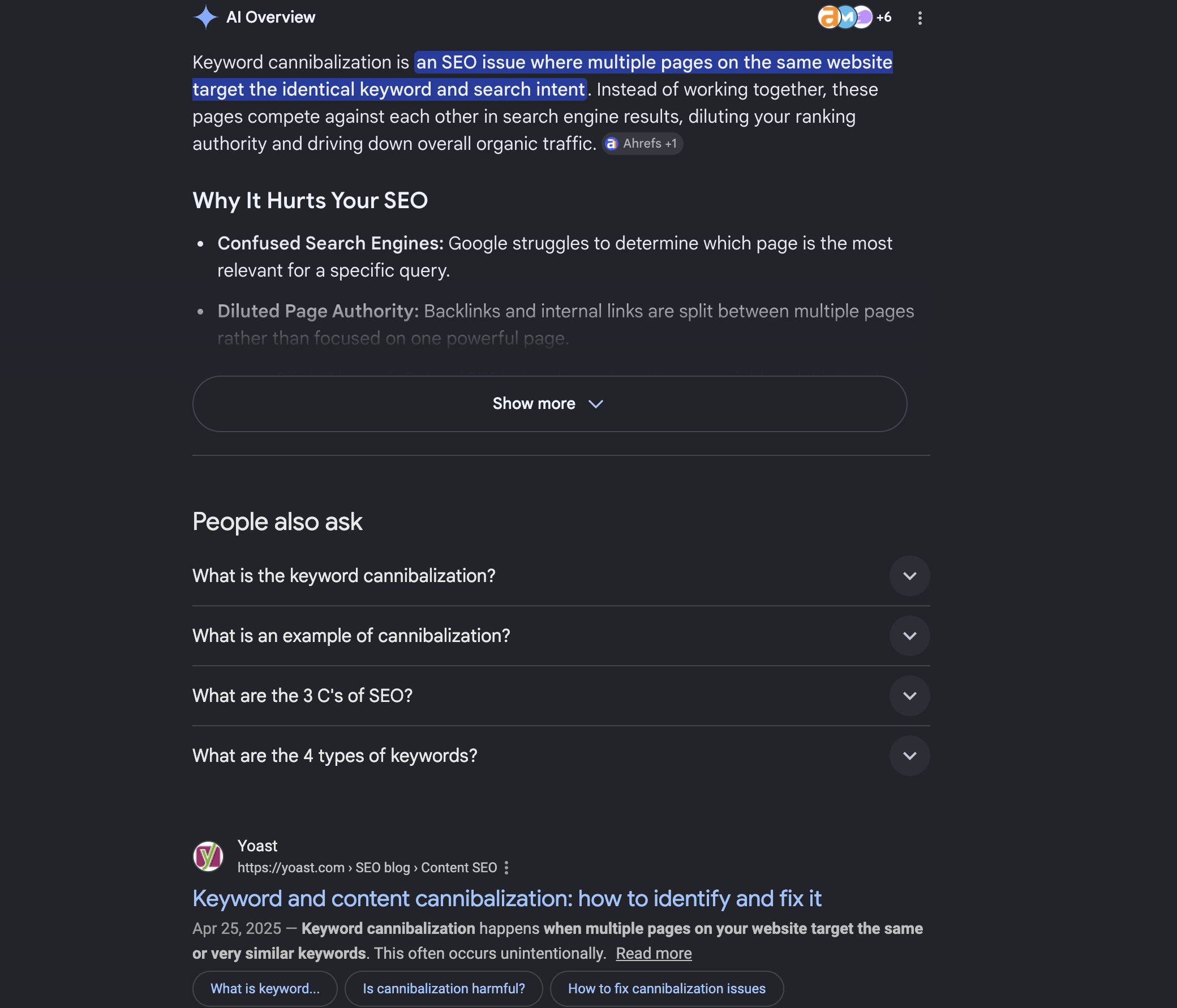
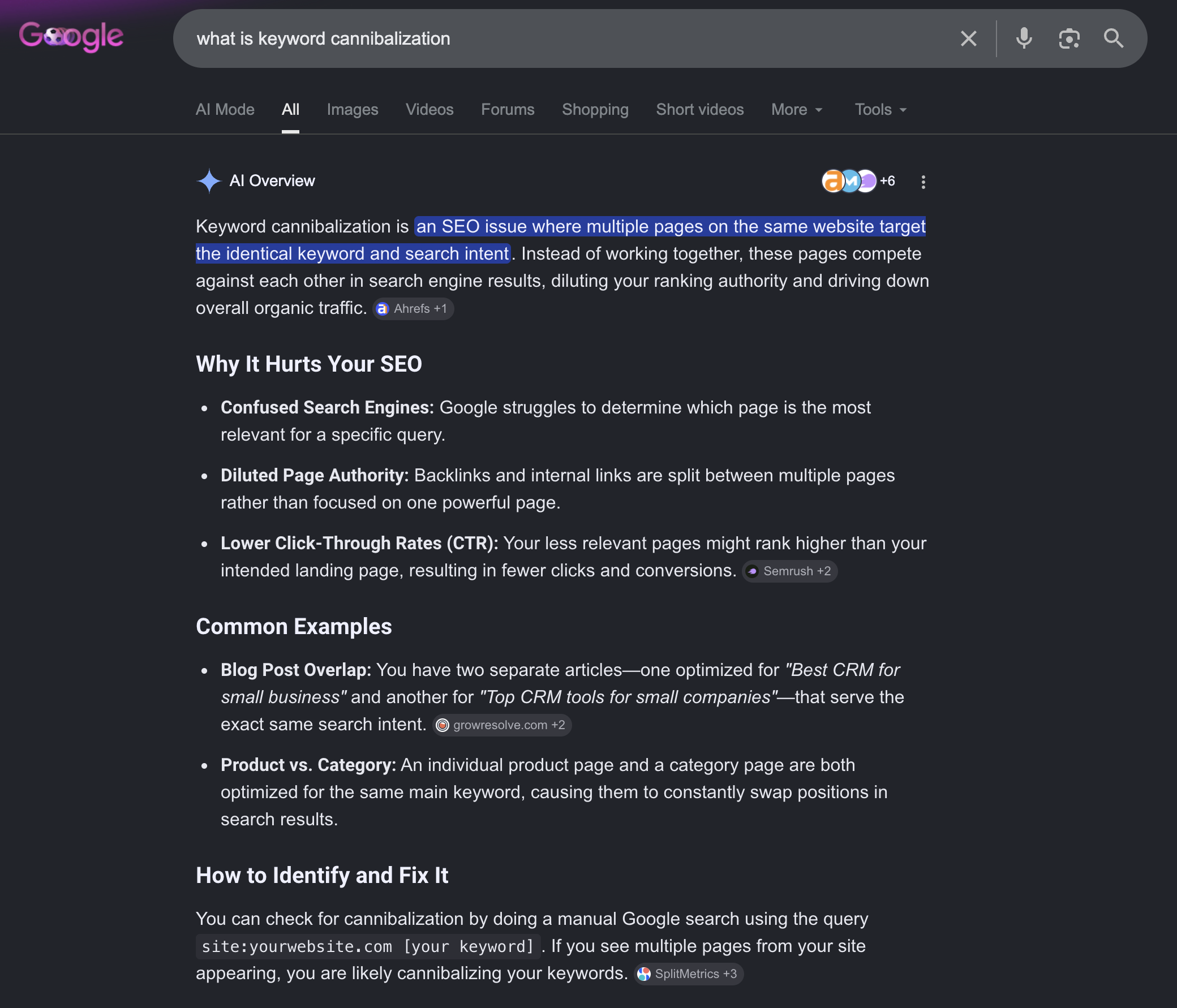
These are the ways you can improve your chances of getting cited by AI:
Lead With the Answer
Build Your Brand as an Entity
This is the most under-discussed shift in AI search. An entity is a distinct thing — a brand, person, or concept — that AI systems and knowledge graphs recognize and connect to other entities. Think of an entity as your reputation in Google’s memory. Models recall brands they understand as clear, consistent entities, which is the same work as building a strong brand. Three things shape how well a model connects you to the concepts you want to own:
Earn Off-Page Signals
It’s tempting to treat AI optimization as purely on-page. It isn’t — but the picture is more nuanced than “rank well and you’ll get cited.” Backlinks and brand mentions still matter, because they matter for SEO, period, and SEO fundamentals still feed AI answers. Just don’t mistake a top ranking for a guaranteed citation; that link is loosening fast.
Use a Content Format that AI Likes
Structured ones. AI engines lift cleanly formatted chunks far more readily than walls of prose, so the highest-leverage move is to break complex ideas into tables, comparisons, and clearly labeled stats. The same Princeton researchers cited earlier found that adding statistics, citations, and quotations raised a page’s visibility in AI answers by 30–40%. Separately, a 2025 analysis of AI citations found that 40–61% of AI Overviews pull from lists or bullet points, and structured, list-based pages get cited noticeably more often than the same content written as prose. None of this is decoration; it’s a core part of how we approach content creation, and it’s what makes a page quotable.
- Listicles: each point is a self-contained chunk a model can lift on its own, which is why list-formatted pages get pulled into AI answers so often.
- Comparison pages: “best X for Y” tables answer a buyer’s exact question, so they get cited heavily on commercial, ready-to-purchase searches.
- In-depth guides: one thorough page can answer many related questions, earning citations across several different prompts.
- Product & service pages: structured descriptions paired with FAQs map directly onto high-intent searches from people ready to buy.
- FAQ / Q&A: the question-and-answer format mirrors how people actually prompt AI, so answers get lifted almost word for word.
- Original research & data: first-party stats and studies give a model something it can’t get anywhere else, so you’re cited as the original source.
How Do You Measure Success in AI Search?
Yes, it’s trackable — just not on the dashboard you’re used to. AI visibility has its own scorecard, younger and rougher than the rankings-and-traffic view you get for classic SEO. Three signals are worth watching, from the most concrete to the most directional.
Common LLM SEO Mistakes
Some of these are old SEO sins; others are specific to how models read and cite. The thread that ties them together: weak content now loses twice. It doesn’t earn the ranking, and it doesn’t get pulled into the AI answer either.
What’s Next for AI Search?
The week-to-week is noisy, but the direction is set, and three shifts are worth planning around.
The first is AI Mode. At Google I/O in May 2026, Google moved it from an experiment to a default part of Search, rolled it out to all U.S. users, and pushed it past a billion people a month. A growing share of queries now get answered before anyone clicks.
The second is measurement. As noted in the section above, Google only began reporting AI Overview impressions in Search Console in mid-2026, and that data will keep maturing, so the guesswork around AI visibility shrinks every quarter.
The third is agentic search. Instead of returning ten links, the engines increasingly run multi-step research on the user’s behalf; Gartner expects task-specific AI agents to be built into 40% of enterprise apps by the end of 2026, up from under 5% a year earlier. That puts even more weight on being the clearly structured, well-corroborated source they pull from.
None of this changes the job; it raises the bar on it. The brands that stay genuinely useful, clearly structured, and well corroborated compound their visibility as these systems mature. The ones chasing each algorithm update do not.
How Do You Know When to Bring in an Agency for AI Search?
You can do a lot of this yourself, and the early wins are worth doing in-house: answer-first headings, cleaner formatting, a few sourced stats. The case for an agency shows up when AI visibility stops being a one-page fix and becomes ongoing work across four moving parts at once — citation-ready content, a consistent brand entity, off-page authority from real coverage, and the tracking to tell whether any of it is landing. When those have to run in parallel every month, a partner earns its keep.
That is the work Resolve is built for. We optimize content so models can lift and cite it, build the entity signals that make AI systems confident about who you are, and earn authoritative coverage through digital PR — then track your share of AI answers so the strategy is measured, not guessed. What makes us different is that we treat this as an extension of real SEO, not a separate trick: the same fundamentals that win rankings, pointed at the place the answer now lives.
Ready to Be the Answer AI Gives?
Tell us the queries and pages that matter to your business, and we’ll build the content, entity, and authority that get you cited — and show you the lift.
Talk to Resolve →What You Get
Frequently Asked Questions About LLM SEO
What is LLM SEO?
Is LLM SEO the same as GEO and AEO?
Is LLM SEO replacing traditional SEO?
What makes a page more likely to be cited in AI Overviews?
Do backlinks and brand mentions still matter for AI search?
How do I measure AI-search visibility?
Which AI should I optimize for?
How do I rank in Google’s AI Overviews?
How do I get my content cited by ChatGPT and other AI tools?
Is SEO dead in 2026?
What is llms.txt, and do I need it?
Contact Us to Get Started!

Director of Content and Link Building Production at Resolve
Danika has been in the SEO profession since 2014, working primarily in content link building, SEO content creation, and people management. Since joining Resolve, she has been in an ever-increasing competition about whose dog is the cutest. She is losing.